

For years, the business case for blogging was fairly straightforward: Target a keyword, publish an article, earn a good search ranking and bring traffic to your website.
That model isn’t dead, but it’s no longer enough.
AI can produce basic informational content in seconds, and buyers have more ways to get answers without clicking through to a company website. If the only job of a blog article is to attract organic traffic, it’s getting harder to justify the investment.
But that doesn’t mean the blog article has lost its value. It means we need to give it a bigger job.
Today, a strong article can become an authority asset: a substantive piece of expertise that builds credibility, supports AI and traditional search visibility and fuels an entire stream of marketing activity.
That changes both what deserves to be published and how we measure its value.
The Article Has a New Job: Become an Authority Asset
Blog articles now need to meet a higher standard. Instead of viewing an article as a single marketing deliverable, think of it as the anchor for an entire stream of marketing activity.
One strong article can fuel:
- Company LinkedIn posts
- Executive LinkedIn posts
- LinkedIn newsletters
- Email campaigns
- Carousels
- Short-form video scripts
- FAQs
- Website copy
- Sales enablement content
- Future articles
The article becomes the place where you develop the idea in depth. The supporting assets carry that thinking into different channels, formats and stages of the buyer journey.
Instead of churning out an endless stream of disconnected articles and hoping some perform well, you build a cohesive body of content around ideas your company wants to own.
Blogging is no longer simply about publishing frequency. It’s about developing ideas, building authority and putting that expertise to work.
What Makes an Article an Authority Asset?
If an article is going to serve as an authority asset, it should be:
- Substantive. It answers a meaningful question rather than merely targeting a keyword.
- Accurate. Industry concepts, claims and terminology stand up to knowledgeable scrutiny.
- Well-sourced. Important assertions are supported by credible, current sources.
- Original. It contributes expertise, perspective, analysis or useful synthesis rather than simply repeating what already exists.
- Discoverable. It is structured so traditional search engines and AI-powered discovery tools can understand its subject and value.
- Activatable. It contains enough substance to generate additional conversations and content across channels.
- Durable. It is valuable enough to update, reuse and revisit rather than discard a few months after publication.
AI Can Draft an Article. It Can’t Own Your Content Strategy.
Once a company is committed to blogging, the next question becomes how to go about blogging. Simply logging into an AI platform, generating a blog and hitting publish is NOT the way to go.
Even with AI, producing the type of high-quality blog that can yield results isn’t as easy as some people assume. AI can accelerate drafting, research, outlining and editing, but drafting is only one part of creating a credible authority asset. Someone still has to:
- Decide what's worth talking about.
- Develop the right angle and point of view.
- Incorporate actual company expertise.
- Verify facts, sources and industry nuances.
- Shape the piece for search and AI discovery.
- Activate it across other channels.
AI can help at nearly every stage. But it doesn't automatically know what your company knows, what your customers care about or which ideas your brand needs to own.
A subtler risk is content that sounds polished but lacks substance. AI-generated material can be technically competent and still feel generic, miss important industry nuance or fail to reflect your company’s actual expertise and point of view.
AI can synthesize what already exists. It doesn’t automatically know your customer insights, proprietary data, real-world experience or the ideas your brand wants to own.
The Biggest Content Problem May Still Be Getting It Done
 Marketing teams aren't short on tools. AI may make drafting faster, but someone still has to own the content process. Topics need to be selected, expertise gathered, claims verified, drafts reviewed and approvals secured.
Consider a typical scenario in which a marketing director identifies a strong topic. The article needs input from the subject matter expert (SME) at the company, but the subject matter expert is busy. The marketing team goes ahead and generates a preliminary draft, but then it needs to be verified. There are questions, and they’re sent to the SME who – you guessed it – is still busy. Other priorities lead to delays, and three weeks later, the article is still sitting in someone’s inbox.
AI may make drafting faster, but someone still has to own the content process. Topics need to be selected, expertise gathered, claims verified, drafts reviewed and approvals secured.
When that process stalls, the cost is bigger than one late article.
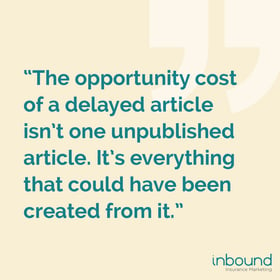
The opportunity cost of a delayed article isn't one unpublished article. It's everything that could have been created from it.
If the article is your authority asset, a one-month delay can also delay the LinkedIn posts, newsletter content, emails, sales tools and other assets that flow from it.
So, How Often Should a Company Blog?
One of the most common questions about blogging is about frequency. How often should you publish?
There isn’t a universal number. Publishing frequency depends on how many subjects you want to build authority around, how quickly your market changes, how much original expertise you have to share and how much supporting content you need.
Publish at the pace at which you can consistently create substantive authority assets and put them to work. For some organizations, that's monthly. For others, it's weekly.
Focus on your strategy, not your content volume.
Stop Measuring an Article as a Single Deliverable
 If a company invests significant resources in creating an article and publishes it once, the economics can be difficult to justify.
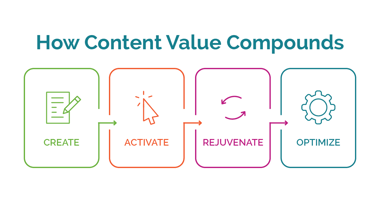
The calculation changes if that same authority asset supports social media posts, newsletter content, email campaigns and sales tools. Update and rejuvenate that article over time, and the original investment can continue creating value long after publication.
Your blogging strategy should offer compounding value. The objective isn't to continually feed a content machine. It's to build a growing library of valuable marketing assets and extract more value from each one over time.
Don't Blog Because You Need Another Blog Post
Blogging still has a place in modern B2B marketing, but that place has changed.
Don't publish simply because the editorial calendar needs another entry. Create an article because your company has a topic worth owning, a question worth answering or expertise worth sharing.
Then don’t stop at publication. Put the article to work across channels, and keep it working by updating and reusing it over time.
Not sure what content you need next?
Use the IIM Content Road Map to determine whether you should create, activate, rejuvenate or build greater authority around the content you already have.