
Creating exceptional content requires a significant investment of time, expertise and budget. Yet many organizations promote a new article, white paper or case study only once before moving on to the next project. As a result, valuable content quickly loses visibility, even though its insights remain relevant. A content activation strategy extends the life of every asset through intentional promotion, repurposing, distribution and ongoing optimization. Instead of treating publication as the finish line, organizations that embrace content activation maximize the return on every piece they create while building stronger thought leadership, increasing engagement and generating more opportunities over time.
Five Key Takeaways
- Publishing content is only the beginning. Promotion and ongoing activation determine its long-term value.
- One article can become weeks or even months of marketing assets across multiple channels.
- Employee advocacy, email marketing, social media, webinars and sales enablement all play an important role in extending content reach.
- Evergreen content should remain in an ongoing promotional rotation instead of disappearing into an archive.
- Updating and refreshing content annually improves credibility, extends search visibility and maximizes return on investment.
Stop Publishing and Start Activating Your Content
Every article has a shelf life. Great marketing extends it.
Companies invest thousands of dollars in developing thought leadership. Subject matter experts devote hours to interviews. Marketing teams research industry trends, gather statistics, write drafts, design graphics and optimize every page for search engines. Leadership reviews the finished product before finally approving publication.
Launch day arrives. The article appears on your website. Someone shares it on LinkedIn. Perhaps it is featured in the company newsletter. A few employees reshare the post. Then everyone moves on to the next project.
Meanwhile, the article that took weeks to produce slowly disappears into the archives. It doesn't have to.
One of the biggest misconceptions in content marketing is that publishing equals promotion. It doesn't. Publishing simply makes content available. Promotion determines whether anyone actually sees it.
The organizations generating the greatest return from content are not necessarily producing more content than everyone else. They are getting more value from every piece they create. That difference comes down to content activation.
The Hidden Cost of Content Decay
Every piece of content begins losing visibility almost immediately after publication. A social media post may receive the majority of its impressions within the first few days. Even outstanding blog articles often experience a sharp decline in traffic after their initial promotion unless they continue to be shared, referenced and updated.
Unfortunately, many marketing teams unintentionally create a cycle of content decay.
The process looks like this:

The cycle repeats month after month. As a result, companies continually invest in creating new content while leaving tremendous value trapped inside the content they already own.
Imagine purchasing an expensive piece of machinery, using it for one day and then locking it in storage. That sounds ridiculous. Yet many organizations do exactly that with their content. Content should not be treated as a one-time campaign. It should be treated as a long-term business asset.
According to the Content Marketing Institute, B2B marketers cite a lack of resources as the most frequent challenge to their content strategy. Marketing teams fall short of their goals because they lack the time, budget and people needed to create effective and scalable campaigns.1
Better content activation helps solve this challenge.
What Is Content Activation?
When you move beyond publication and start thinking about activating the full value of each piece, it’s easy to see how one investment can create dozens of promotional opportunities.
The Content Activation Mindset
Most companies think about content in two phases: Create it. Publish it.
High-performing marketing organizations recognize that content publication is only the beginning of a much longer lifecycle. Every article should continue generating awareness, engagement and business value long after launch day.
Principle 1: Launch Is the Beginning, Not the Finish Line
Instead of planning one release, plan many touchpoints.
Principle 2: Activate Your Employees Before Your Audience
One of the most underutilized marketing channels already works inside your organization: your employees.
Too often, new content is published without anyone internally knowing it exists. Marketing posts the article. Sales never sees it. Customer service doesn't know it's available. Executives forget to share it. The opportunity is lost before external promotion even begins.
Instead, make internal activation your first priority.
When new content is published, announce it internally, explain why it matters and encourage employees to reshare the company post or create their own posts. Explain how sales teams can use it during prospect conversations and make it easily accessible online.
Employee advocacy has become an increasingly important part of B2B marketing because people are generally more likely to trust content shared by a brand’s employees than by the brand’s executives.2 More importantly, internal activation aligns the entire organization around a common message. Everyone tells the same story.
Principle 3: One Idea Should Become Many Assets
Creating original content is often the most expensive part of content marketing. Repurposing it is where efficiency begins. Consider a white paper. Most organizations publish it as a downloadable PDF and stop there. A content activation strategy asks: What else can this become?
The answer is usually far more than people realize. In many cases, one well-researched article can support months of marketing activity while continuing to direct readers back to the original resource. That is the essence of content activation.
Principle 4: Meet Your Audience Where They Consume Information
When you create multiple versions of the same core content, you make it easier for different audiences to engage in the way they prefer. For example, imagine you've published a white paper on cyber insurance.
Each asset points back to the original resource while serving a different audience and a different stage of the buyer's journey. Research from LinkedIn and Edelman has shown that most B2B decision-makers and executives say thought leadership has prompted them to research a product or service they had not been considering previously, and they are more receptive to sales or marketing from companies that consistently produce quality thought leadership.3
Principle 5: Build a Resource Center, Not Just a Blog
Publishing an article is important. Making it easy to find six months later is even more important. Too many websites treat content as a chronological archive. Once an article drops off the first page of the blog, it becomes increasingly difficult to discover unless someone finds it through search.
Instead, think like a publisher.
Create a searchable resource center organized around the categories of questions your audience is asking.
Now your content becomes a knowledge library rather than a news feed. Every new piece of content should have a permanent home. If your best insights are difficult to find, they cannot continue generating value.
Principle 6: Put Every Asset on a Rotation Schedule
One of the most overlooked concepts in content marketing is scheduled reactivation. Many companies assume that because they shared an article once, everyone who follows them has already seen it. That simply isn't true.
Algorithms determine what appears in social media feeds. New followers join every week. Employees change companies. Prospects enter the buying process months after you originally published an article.
The reality is that most of your audience never saw your original post, and even if they did, they probably don’t remember it. That creates an opportunity.
Over time, one article becomes dozens of touchpoints. That is how thought leadership compounds.
Principle 7: Refresh Content Annually
Evergreen topics often remain valuable for years, but statistics become outdated, screenshots change and industry regulations evolve. Instead of starting over, establish an annual content review process.
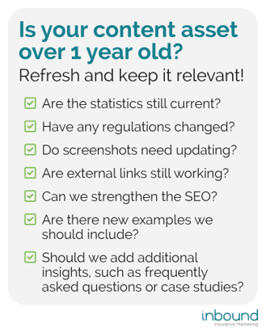 Review every major article and ask:
- Are the statistics still current?
- Have any regulations changed?
- Do screenshots need updating?
- Are external links still working?
- Can we strengthen the SEO?
- Are there new examples we should include?
- Should we add additional insights, such as frequently asked questions or case studies?
In terms of search ranking, Google favors helpful, reliable and people-first content.4 Updates that support these factors may help your page, especially for queries that require recent content,5 but simply slapping a new date on old content won’t help.6
When done right, refreshing existing content is frequently one of the highest-return activities a marketing team can undertake. You're building on an existing asset rather than beginning from zero.
The Content Activation Flywheel
Content has a lifecycle and many organizations only focus on the first 10% of it. They invest heavily in creating great content, celebrate publication and immediately move on to the next project. The companies that consistently build authority recognize that publishing is only the beginning.
Every article becomes an opportunity to educate, engage and build trust across multiple channels and over an extended period of time. When one article becomes dozens of marketing assets, months of promotion and years of search visibility, the return on investment changes dramatically.
That's content activation. And that's where the real return on your content investment begins.
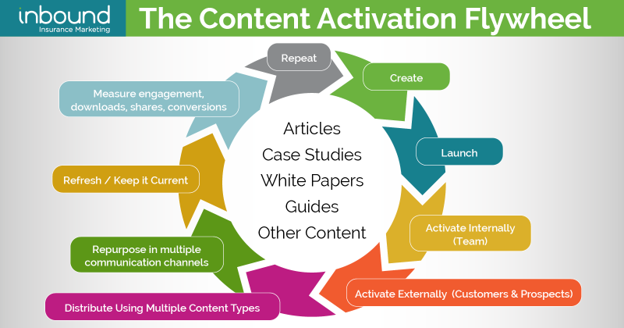
Unlike a traditional campaign that ends after launch, the flywheel continually generates momentum. Each stage reinforces the next. The more consistently you activate your content, the more value every future piece creates.
Measure What Matters
A content activation strategy should support meaningful business outcomes. Many organizations focus on vanity metrics such as likes or follower growth. While those metrics can indicate whether content is reaching an audience, they don't tell the whole story. Instead, measure content based on how it contributes to broader marketing and business objectives.
Some of this data is difficult to track, but any insights you can uncover will help you refine future activation efforts. Over time, you'll discover that certain formats consistently outperform others. Every campaign becomes an opportunity to learn.
The Organizations That Win Are Publishing Smarter
The pressure to produce more content has never been greater. Marketing teams are expected to publish articles and resources, maintain active social media channels, produce videos, support sales, build email campaigns and demonstrate measurable return on investment.
Every article, guide, case study and white paper represents a significant investment of expertise, time and budget, so it’s more important than ever the squeeze the most value out of every piece of content. Content should keep on working long after launch day.
Content should be treated as a long-term business asset instead of a short-term marketing project. That's the difference between content publishing and content activation.
Sample Content Activation Checklist
Ready to Create and Activate Your Content?
Inbound Insurance Marketing helps insurance organizations create great content and extend the reach and value of every content investment. We understand that creating great content is only half the job. Making sure people see it is where the real value begins.

Sources
- Content Marketing Institute. B2B Content Marketing Benchmarks, Budgets, and Trends: Outlook for 2025. https://contentmarketinginstitute.com/b2b-research/b2b-content-marketing-trends-research-2025
- 2025 Edelman Trust Barometer. https://www.edelman.com/trust/2025/trust-barometer/special-report-brands
- 2024 Edelman-LinkedIn B2B Thought Leadership Impact Report. https://www.linkedin.com/business/marketing/blog/research-and-insights/b2b-thought-leadership-research-impact-linkedin-edelman
- Google Search Central. Creating Helpful, Reliable, People-First Content. https://developers.google.com/search/docs/fundamentals/creating-helpful-content
- Search Engine Land. Query Deserves Freshness: What it is and how it works. https://searchengineland.com/guide/query-deserves-freshness-qdf
- Search Engine Land. Is Fresh Content A Google Ranking Factor? https://www.searchenginejournal.com/ranking-factors/fresh-content/