
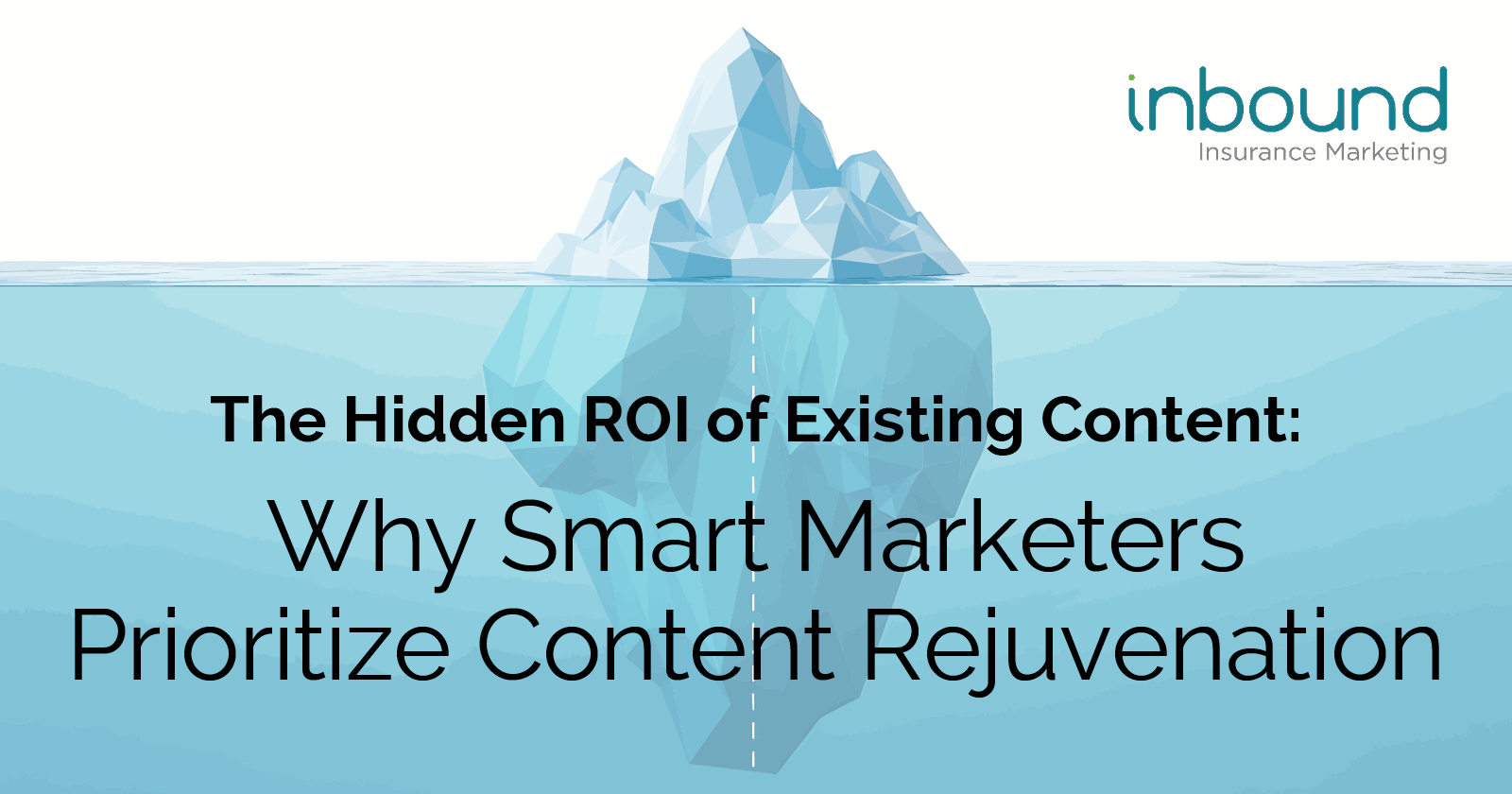
The goal of content marketing isn’t to produce as many new pieces as possible. The goal is to derive value from the entire body of content you’ve published, including new pieces as well as old material. Many marketing departments focus on producing new content. As a result, old content is neglected, and its value is unrealized.
Don’t get me wrong – we love producing fresh content, and it will always be an essential component of B2B marketing. What most people miss is the opportunity to maximize every content investment. When you buy a car or a home, you have to maintain it. The same is true with content assets.
When you update, expand and improve existing content instead of ignoring it, you're building on an asset that's already working. Content rejuvenation is where you see the true ROI of content.
Content Is an Appreciating Asset
Some marketing materials start to lose value almost immediately. Content is different.
Content isn't supposed to depreciate. In fact, the best content becomes more valuable over time as it earns search rankings, backlinks, internal authority and audience trust.
Compare it to other investments.
A quality white paper, case study, or blog post can continue generating traffic for years. Every month your content survives, it may accumulate:
When you replace your content, you start from scratch. The new article has no backlinks, no social shares, no indexed history. Sometimes, this makes sense. You have new topics to cover, new points to make, and new services to promote. Other times, starting over is a waste. The new article competes with a nearly identical piece that already exists, diminishing the value of both.
Instead of replacing an old but valuable asset, rejuvenation improves it.
Existing URLs Have Built-In SEO Equity
Older URLs often have accumulated backlinks, domain trust, historical click data, impressions, engagement signals and keyword rankings. A brand-new page has none of these and is therefore at a disadvantage when it comes to organic search.
However, this doesn’t mean that old URLs always perform well. Some may not receive views anymore because the material is out-of-date and the resource has been forgotten. The solution isn’t always to abandon the old URL and start over. Instead, you can retain the URL and update the content to add depth and freshness. You can also adjust your SEO strategy with new keyword targeting, an improved user experience and better AI visibility.
Freshness Matters to Google, But It’s Query Dependent
Freshness in ActionYou have a five-year-old article that contains useful information, but the statistics are no longer current, and a couple of references to technology feel dated. You could write a brand-new article on the same topic with a new title and URL, or you could keep the URL and update the content. The latter can provide more value because you’re retaining the authority of the old URL. |
Google's definition of content freshness is narrower than many people assume. It does not mean newer is always better. Instead, Google uses freshness when the query suggests users expect recent information. Google calls these "query deserves freshness" (QDF) systems.
For example, if someone is searching “best homeowners insurance,” Google may look for the newest content because the market is always changing. Likewise if someone searches for “hurricane forecast,” up to the minute information is essential.
For other searches, like “What is workers’ compensation insurance?” freshness is not as big of a factor. Instead, Google’s search signals focus on meaning, relevance, quality, usability and context to return relevant results.
For marketers, this means that content should be updated when it improves usefulness, not simply because it's old. However, for queries where information changes over time, freshness can be an important ranking factor, and meaningful updates can improve relevance.
Examples of information that may justify freshness updates include:
AI Search Rewards Fresh, Well-Structured Resources
Google Search may not always reward freshness, but AI chatbots can work a little differently. AmICited has analyzed more than 768,000 AI citations across multiple AI chatbots, and the results are a revelation for marketers. Although 26% of brands have no AI mentions, the right content strategy could help these brands increase their AI visibility.
First of all, blogging can earn AI mentions. Google AI is especially likely to cite blog posts, with blogs appearing in 46% of citations. Perplexity cites blogs 38% of the time, and ChatGPT does so 21% of the time.
 But not all blog posts are effective.
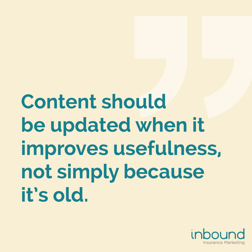
Fresh content is critical. AmICited found that AI systems have a 25.7% preference for fresh content, and recently updated pages are more likely to receive citations than older content that covers the same topics.
Other factors that can boost citation frequency include AI-friendly formats that provide structured data, such as comparisons, lists, how-to guides and FAQs.
Instead of creating multiple shallow articles, brands can pursue AI citations by updating existing content to keep it fresh. Adding FAQs and other types of structured data during the update can increase the likelihood of AI mentions even more.
Beyond Search: Six Reasons to Update Old Content
#1: Strengthen Internal Links
Internal linking is a simple and effective way to boost site authority. When you abandon old content, you weaken this strategy. When you refresh old content, you strengthen all the content that links to it.
Imagine you've published 200 articles, dozens of resources and a handful of service pages. Many of your articles link to each other as well as relevant service pages and resources.
You can also improve your internal link strategy when you update content. The update is an opportunity to:
#2: Capitalize on Data-Driven Insights
Old content has performance history that provides insights into what both readers and Google search algorithms favor. New content, by its very nature, lacks this performance history.
For old content, Google Search Console already tells you:
You can use insights from analytics to reveal which pages have high bounce rates, which ones earn strong engagement, and which ones actually succeed in converting readers. With this information, you can refine your strategy to improve your results. When you create a new page, you start all over. Instead of tweaking your page based on actual data and real user behavior, you’re guessing at what might work.
#3: Protect Existing Backlinks
Earning a backlink from a respected website is like hitting SEO gold. Once you have trustworthy backlinks, you want to protect them.
If you publish replacement articles instead of updating originals, you risk splitting authority. Some backlinks go to the new content, some go to the old content, and no single piece reaches its full SEO potential.
Even worse, readers who click on backlinks to old, outdated content may quickly realize that the information is no longer useful and click away immediately. By updating the content, you increase its value, encouraging readers to stay on your site longer and explore other resources there.
#4: Boost Conversion Rates
Website traffic on its own accomplishes nothing. If thousands of people click on your website every day, but none of them ever become customers, your content is not fulfilling its objective. This is why you also have to consider metrics like bounce rates and, most importantly, conversion rates.
Older articles that haven’t been updated often undermine your conversion goals.
Imagine you have a great article on an in-demand topic. Even though it’s old and some of the statistics are outdated, it still manages to get some organic traffic. But the internal links are either broken or lead to products you no longer offer, and the CTA promotes an event that happened five years ago. The article no longer serves a purpose – but it still has value. If you update the article with working links, a new CTA and fresh statistics, you can tap that value.
#5: Stretch Every Dollar You Already Spent
Updating an existing article often requires a fraction of the investment required to create a new article from scratch. Whether you’re using an in-house content team or you’re outsourcing your content creation to a third party, this results in savings.
But the real benefit isn’t the money you save. It’s the value you gain.
Creating a quality article requires research, writing, editing, design, SEO, approvals, publication and promotion. It’s an investment. It can be a good investment, but not if you’re squandering your resources.
Compare an investment in content to other investments. You wouldn’t purchase a summer home for a single vacation and never use it again. That would be a waste. You’d renovate the property and find other uses for it. It’s the same with content.
When you squeeze as much value as possible from every piece of content, your marketing dollars go further. As a result, you can reinvest your savings on new projects.
#6: Content Creates Compounding Returns
Churning out low-quality articles that rehash the same topics again and again is a shortsighted approach. You’re throwing spaghetti against the wall, hoping that something will stick. The result is a mess.
Content marketing works best when it’s approached as a long-term strategy. Most content doesn’t go viral, especially when you’re writing for an industry like insurance. However, over time, your content can build value – if you let it.
Over the course of several years, companies that focus on content rejuvenation aren't just creating an endless stream of content that gets lost in the noise of the internet. They're building a stronger knowledge library.
That library becomes an asset. It’s also a differentiator. These days, anyone can use AI to create a high-volume content strategy. A library that derives its value from accumulated, carefully curated history is much harder to replicate.
Volume Is Not the Goal
 Companies often assume the path to more traffic is publishing more articles, but think about it from the reader’s perspective. You’re trying to research a topic. One website has dozens of articles on the topic, but they’re all shallow and repetitive, and many are out of date. Another website only has a couple of articles on the topic, but they’re both in-depth and current. The latter is clearly more useful.
This doesn’t mean that volume is bad. It’s great to have a lot of high-quality articles. However, volume alone should not be the goal.
Every mature content library contains hidden value. The organizations that consistently audit, improve and reconnect their existing content don't just reduce marketing costs. They also create a portfolio of digital assets that compounds in value over time.
Inbound Insurance Marketing can help you build a content strategy that includes building new content assets, activating current content assets and rejuvenating older content assets.
Want to share these ideas with your team?

Frequently Asked Questions About Content Rejuvenation
Content rejuvenation is the process of updating, expanding and improving existing content to increase its value over time. Rather than replacing content that still has authority, backlinks and search visibility, rejuvenation builds on those assets by improving accuracy, depth, user experience and SEO performance.
Both are important components of a successful content strategy. New content allows you to cover emerging topics, launch new products and address new customer questions. Content rejuvenation focuses on maximizing the return on the content you've already invested in by improving existing assets that still have value.
Older content often has accumulated search authority, backlinks, internal links and historical performance data. Updating an existing article allows you to preserve those assets while improving the content for today's audience. In many cases, this can be more efficient than starting from scratch.
It can, but there are no guarantees. Google has stated that freshness is an important ranking signal for queries where users expect current information. Meaningful updates that improve accuracy, usefulness and relevance may help maintain or improve search performance, particularly for topics that evolve over time.
There is no universal schedule. Review your highest-value content at least once a year, and revisit articles more frequently if they cover rapidly changing topics such as technology, regulations, market trends or product information.
Start with content that already demonstrates value, such as pages that:
- Generate consistent traffic
- Rank on the second or third page of search results
- Have earned quality backlinks
- Support important products or services
- Contain outdated information or broken links
These pages often provide the greatest opportunity for improvement.
A comprehensive content update may include:
- New statistics and research
- Current industry trends
- Updated examples
- Improved headings and formatting
- New internal links
- Better calls to action
- Updated images or graphics
- Enhanced metadata
- Structured data (schema markup), where appropriate
- AI-friendly formatting, such as FAQs and comparison tables
Usually, no. If the existing URL has earned authority, backlinks and search visibility, keeping the same URL allows you to preserve that value while improving the content. A new URL is generally appropriate only when covering a substantially different topic.
It can. AI search platforms tend to favor content that is current, well organized and easy to interpret. Updating existing resources with accurate information, clear headings, FAQs, comparison tables and authoritative sources may improve the likelihood of being cited by AI-powered search experiences.
Measure results using metrics such as:
- Organic traffic
- Search rankings
- AI citations and referrals
- Engagement metrics
- Conversion rates
- Time on page
- Lead generation
- Internal link performance
Comparing these metrics before and after an update helps determine whether the rejuvenation delivered meaningful business value.