
Artificial intelligence is rapidly changing how people research companies, products and services. Increasingly, buyers are asking ChatGPT, Google AI, Perplexity, Gemini and Microsoft Copilot for recommendations instead of scrolling through pages of search results. That shift is creating a new marketing challenge: earning AI visibility. While traditional search engine optimization remains essential, organizations that want to become part of AI-generated answers must focus on something even more important: trust. The companies that consistently publish original expertise, build industry authority and amplify their knowledge across multiple channels are positioning themselves to become trusted sources for both people and AI.
Five Key Takeaways
Search Has Changed Again
For more than two decades, digital marketing followed a familiar playbook: Build a strong website, optimize your pages for search engines, earn backlinks, create valuable content and improve your rankings.
Those fundamentals still matter.
Google processes billions of searches every day, and search engine optimization remains one of the most effective ways to attract qualified visitors. But something important has changed. Increasingly, buyers are no longer relying solely on traditional search engines. They're asking AI instead.
Instead of typing a series of keywords into a search engine, they're asking questions, and instead of returning a list of blue links, AI assistants deliver a synthesized answer.
For marketers, that represents one of the biggest shifts in online discovery since the introduction of search engines themselves. The first impression of your company may no longer happen on your website. It may happen inside an AI-generated response.
AI Search Is Moving Into the Mainstream
This shift is happening faster than many organizations realize. According to G2's 2026 AI Search Insight Report, slightly more than half of B2B software buyers now say they begin product research with an AI assistant more often than a traditional search engine.1
At the same time, AI-driven referral traffic continues to climb as ChatGPT, Google's AI experiences, Perplexity, Gemini and Microsoft Copilot become part of everyday research workflows.2
Google's own evolution reflects the trend. AI Overviews now appear across a growing share of informational searches, and AI Mode expands conversational search even further by allowing users to continue exploring topics without leaving the search experience.3
Taken together, these changes point to a larger reality: Search is no longer just about ranking. It's about being recommended.
AI Visibility Is the Next Evolution of SEO
The marketing industry has responded to this shift with new terms such as Answer Engine Optimization (AEO) and Generative Engine Optimization (GEO). While the terminology may evolve, the objective remains the same: to help people find trustworthy information.
The difference is that AI assistants don't simply retrieve webpages. They evaluate information, synthesize it and present a recommendation. That means marketers must think beyond rankings alone. Visibility now depends on whether your organization is viewed as a trustworthy source.
Fortunately, this doesn't require abandoning SEO; it requires building on it. Think of it this way: SEO helps search engines understand your website. AI visibility helps AI systems understand whether your organization is trustworthy enough to recommend. That's an important distinction.
Many companies are looking for technical shortcuts that will supposedly "optimize" content for AI, but there aren't any sustainable shortcuts. Just as Google spent years rewarding genuinely useful content over keyword manipulation, AI systems are increasingly favoring organizations that consistently demonstrate expertise, authority and credibility.
Trust has become the new competitive advantage.
AI Doesn't Reward Volume; It Rewards Trust
One of the biggest misconceptions surrounding AI visibility is that publishing more content automatically improves your chances of being cited. It doesn't. AI systems are designed to identify reliable information, not simply abundant information.
Although every platform uses different methods, they generally evaluate similar characteristics:
Notice what's missing from that list. There is no mention of publishing hundreds of AI-generated blog posts. There is no shortcut based on keyword density, and there’s no single technical setting that suddenly makes your content AI friendly.
The organizations best positioned for AI visibility are often the same organizations that have spent years investing in quality content marketing. Trust is built by consistently helping your audience make better decisions.
Introducing The Inbound AI Visibility Framework
If trust is the goal, how do organizations earn it? At Inbound Insurance Marketing, we believe AI visibility is built through five connected pillars. Together, they create a digital reputation that both people and AI can trust.
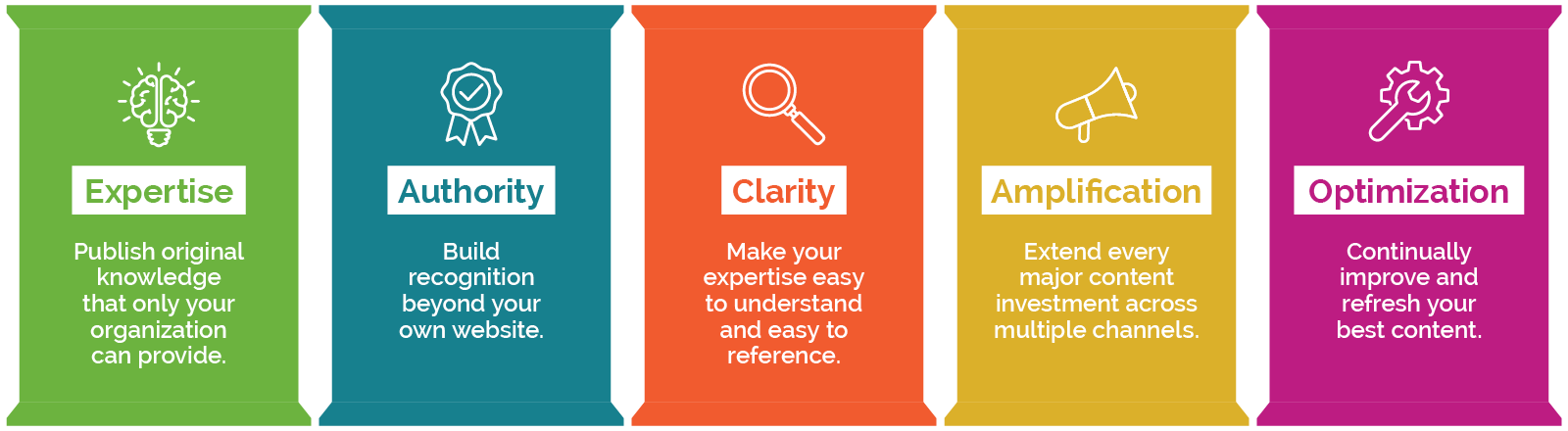
Organizations that consistently strengthen all five pillars are not simply improving their SEO; they're building long-term AI visibility.
From Expertise to AI Recommendation
Trust develops through consistent signals that demonstrate expertise, credibility and value over time. Together, they create a digital presence that is more valuable to customers and more likely to be referenced by AI.
 Pillar One: Expertise
Every organization has access to AI writing tools. Very few organizations have genuine expertise and that distinction matters. Artificial intelligence can summarize existing information. It cannot replace decades of industry experience, firsthand customer knowledge or original research. Those remain uniquely human advantages. The organizations most likely to earn AI visibility are publishing better ideas and answering the questions customers ask every day.
Those answers become original thought leadership because they come directly from experience. One practical exercise is to keep a running list of the questions your sales, customer service and technical teams answer every week.
One of the fastest ways to differentiate your content is to contribute something new.
That might include:
Original information gives other publishers something to reference, and more importantly, it gives AI systems information they cannot simply find everywhere else.
 Pillar Two: Authority
Expertise exists inside your organization. Authority develops when other respected organizations acknowledge your expertise. That recognition can take many forms:
These activities do more than increase brand awareness; they reinforce credibility.
In an environment filled with AI slop, credibility is everything. That's one reason executive thought leadership has become increasingly important. People want to hear directly from subject matter experts. If your CEO regularly writes about insurance innovation, speaks at industry events and appears on podcasts discussing AI in claims, that expertise becomes part of your organization's broader digital identity. Authority is not manufactured; it is accumulated.
 Pillar Three: Clarity
Even the most knowledgeable organizations can undermine themselves with overly complicated communication. People are busy so they tend to scan before they read and so do AI systems. Both prefer to scan well-organized content.
Therefore, it’s important to write and format for increased clarity. Effective content typically includes:
When readers immediately understand your content, they are more likely to trust it. The same principle applies to AI. The easier your expertise is to interpret, the easier it becomes to reference. The strongest thought leadership explains concepts plainly, defines unfamiliar terminology, uses examples and breaks complex topics into manageable pieces.
A reader should leave your article feeling smarter than when they arrived. Google continues to emphasize that helpful, people-first content should prioritize satisfying readers rather than attempting to manipulate search rankings.4 Those same principles increasingly support AI visibility.
 Pillar Four: Activation and Amplification
This is where many organizations unintentionally limit their own success. They invest weeks creating an outstanding article. Then they publish it, share it once on LinkedIn and move on.
Unfortunately, that's often where the article's visibility begins to decline. The organizations building long-term authority recognize that publishing is simply the beginning of a much larger campaign. One article should become an entire ecosystem of content.
For example, a comprehensive guide can become:
Amplification serves two purposes. First, it increases the likelihood that potential customers encounter your expertise. Second, it creates additional trust signals that reinforce your credibility over time.
The second purpose is often overlooked. Many marketers think of social media primarily as a distribution channel. However, it is increasingly an authority channel. Every post contributes to your organization's digital footprint. AI systems don't evaluate only your website; they also evaluate the broader ecosystem surrounding your brand.
 Pillar Five: Optimization
One of the biggest misconceptions about content marketing is that publishing marks the end of the process. In reality, publication is where optimization begins. As markets evolve, regulations change, technology advances, and customer questions shift, your content should evolve, too.
Organizations that consistently update and improve their best resources create a significant long-term advantage over those that continually chase new topics while allowing older content to become outdated.
Think of your content as an asset, not a campaign.
Assets appreciate when they're maintained.
Every six to 12 months, review your most important content and ask:
Each update strengthens the value of the original investment.
The result is content that becomes more authoritative over time rather than quietly fading into your archives.
AI Visibility Is Bigger Than SEO
SEO remains essential. Without a technically sound website, search engines and AI platforms will struggle to discover and understand your content. But SEO alone is no longer enough.
SEO helps people find your website; AI visibility helps AI confidently recommend your organization. Those objectives overlap but they are not identical.
Organizations that combine SEO with expertise, authority and amplification are far more likely to become trusted sources. That difference will become increasingly important as AI continues reshaping how buyers discover information.
The AI Visibility Checklist
Every significant content investment should strengthen your authority. Before publishing your next article, ask yourself these questions.
Expertise
Authority
Clarity
Amplification
Optimization
If the answer to each of these questions is yes, you're doing far more than publishing another article; you're building long-term authority.

The New Rules of AI Visibility
Publishing creates content. Amplification creates authority. Authority creates AI visibility.
Trust has become one of the most valuable business assets. Edelman's research shows that the majority of consumers cite trust in a brand as important or a dealbreaker when deciding whether or not to use that brand.5 Organizations that use their content strategy to develop authority and credibility are better positioned to win over both AI chatbots and customers.
Sources
- G2. The Answer Economy: 2026 AI Search Insight Report. https://learn.g2.com/g2-2026-ai-search-insight-report
- Search Engine Land. "ChatGPT AI referral traffic sessions continue to grow." 2026. https://searchengineland.com/chatgpt-ai-referral-traffic-sessions-data-481630
- Google Search Central. AI features and your website. https://developers.google.com/search/docs/appearance/ai-features
- Google Search Central. Creating Helpful, Reliable, People-First Content. https://developers.google.com/search/docs/fundamentals/creating-helpful-content
- 2025 Edelman Trust Barometer. Special Report: Brand Trust, From We to Me. https://www.edelman.com/trust/2025/trust-barometer/special-report-brands