
Getting mentioned by ChatGPT once is not the new version of ranking No. 1 on Google. AI answers change, sources change and the brands included in an answer can shift from one prompt to the next.
That means the real goal isn’t to win a single AI mention. It’s to become one of the brands that keeps showing up.
Doing that requires something bigger than optimization. It requires becoming an anchor brand, a company so strongly associated with a particular area of expertise that it repeatedly becomes part of the answer.
One AI Mention Doesn’t Mean You’ve Won
If an AI platform mentions your brand, that’s encouraging. But it’s not proof that you’ve established visibility.
AI answers aren’t static rankings. Getting mentioned once may seem impressive, but it doesn’t guarantee that you’ll ever be mentioned again.
In recent MaxAEO analysis of 1,247 buyer-intent prompts across eight AI platforms, 17% changed at least one recommended brand from one day to the next. When prompt wording changed, that figure rose to 54%. Even the top recommendation was unstable: 65% of prompts changed their No. 1 brand at least once.
That volatility changes the objective. The goal is not to appear once. It is to become one of the brands that survives the rotation.
What Is an Anchor Brand?
 According to MaxAEO, anchor brands are companies that survive that daily rotation of AI mentions. In ChatGPT, for example, four to nine brand mentions rotated while an average of 2.3 brands remained in at least 80% of the daily responses studied. If you can establish your brand as one of those 2.3 anchor brands, you can achieve consistent AI mentions. It’s the equivalent of ranking in the new world of AI search.
Here’s another way of thinking about it. If you’re discussing a topic, there are a lot of details you can mention. However, some facts are so central to the topic that they’re nearly guaranteed to come up. If your brand falls into the first category, you might snag a mention now and then, but it comes down to luck. If you can make it into the second category, you’ll be mentioned more often than not.
When looked at this way, it becomes clear that the goal isn’t just to get ChatGPT and other AI chatbots to mention your brand. Instead, the bigger strategic objective is to ensure that when someone thinks about your niche, your brand belongs in the conversation. An anchor brand is not necessarily the only answer. It is one of the expected answers.
Why Anchor Brands Matter in AI Search
To determine which factors affect brand mentions in Google’s AI Overviews, Ahrefs analyzed 75,000 brands. Web mentions emerged as the clear winner. Other factors like backlinks and organic traffic from branded keywords had an impact, but not nearly as strong. It’s also important to note that paid brand mentions were not very influential.
The findings suggest that broader web mentions may be an important signal of AI visibility. In other words, it matters not only what your brand says about itself, but whether other sources talk about your brand and expertise.
In the pre-AI internet, marketers often dreamed of having a piece of content go viral. Things have changed. Now the goal is to get people talking about your company, not a single piece of content. Content still plays a pivotal role, but the objectives are shifting.
Anchor Brands Don't Own Keywords. They Own Ideas.
Traditional search is organized heavily around queries and keywords. AI discovery is broader. It connects entities, concepts, questions and sources. The objective is no longer simply to rank for a phrase. It is to become associated with an idea.
For example, if you sell commercial insurance in Cleveland, you want to be associated with insurance for businesses in Ohio. From here, you can build an ecosystem of associations, branching off into small business insurance, risk management solutions, and other connected ideas. You’re not just focusing on long-tail keywords and variations of similar phrasing. You’re demonstrating that you’re the go-to brand for a network of related concepts.
You do this by establishing your expertise in a domain through articles, social media posts, white papers, case studies and other pieces of thought leadership.
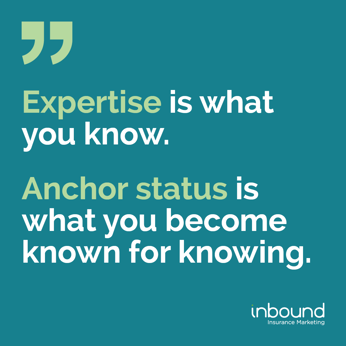
Expertise is what you know. Anchor status is what you become known for knowing.
And that distinction matters because you cannot simply declare yourself an anchor brand. Authority doesn’t exist until it’s recognized by others.
You could publish 500 articles saying your company understands cyber risk. Repetition alone does not create authority. Authority becomes much stronger when other people begin making the association for you.
AI models recognize this, and it affects AI responses. In fact, a study found that 85.7% of URL citations point to third-party sites, while only 14.3% point to brand-owned sites.
Owned authority establishes the case. Earned recognition validates it.
Anchor Brands Build Topic Ecosystems
A brand that wants to become associated with workers’ compensation, for example, needs more than one authoritative article. It needs useful perspectives on the questions, risks, trends, decisions and problems surrounding workers’ compensation.
That ecosystem might include:
core idea → customer questions → subtopics → original research → executive perspectives → case studies → third-party commentary → multiple formats
The individual pieces matter. The association created by the body of work matters more.
Then, if you want to mention the Content Capsule:
We call this structured body of interconnected content a Content Capsule.
Consistency Is Your Competitive Advantage
AI visibility does not come from finding a single publishing formula. What brands can control is whether they contribute useful, distinctive expertise consistently enough to become associated with the subjects that matter to them.
One excellent article demonstrates expertise. A sustained body of useful thinking about published across owned channels and reinforced by third-party recognition, begins to create an association. That’s the difference between publishing expertise and occupying territory.
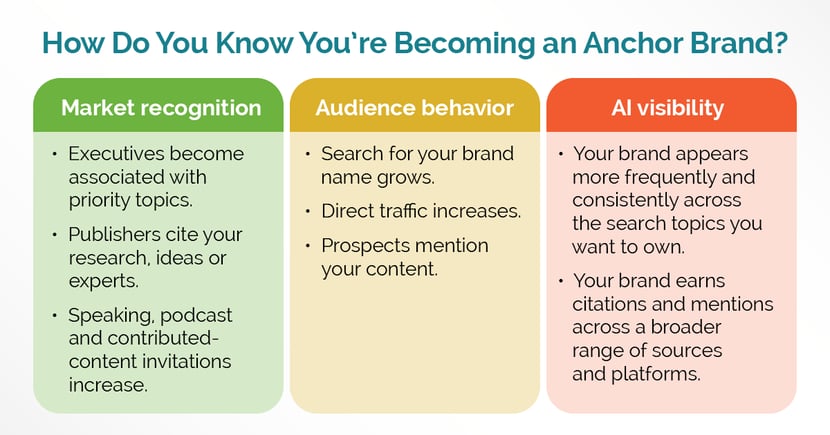
The question isn’t whether ChatGPT mentioned you once. It’s whether your brand is becoming consistently associated with the subjects you want to own.
From Visibility to Recognition
Your company already has expertise in its domain, but having expertise is just the beginning. Now you have to demonstrate your expertise consistently, earn recognition and build strong associations.
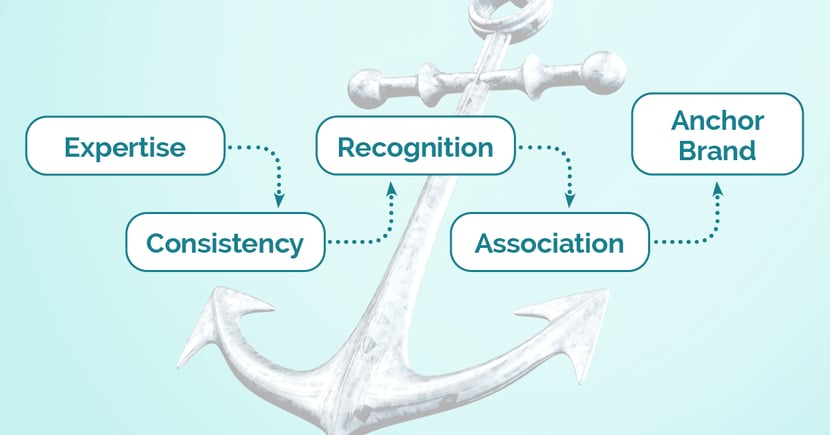
Becoming an anchor brand requires more than publishing more content. It requires consistently demonstrating expertise until the market begins reinforcing the association for you.
When customers, journalists, brokers, associations, subject-matter experts, search engines and AI systems repeatedly encounter useful expertise from the same organization, visibility starts becoming recognition.
And recognition becomes reputation. Search rankings can change overnight. Reputation is much harder to displace. That is the real opportunity behind the anchor-brand strategy.