

As your insurance organization tries to build its brand and expand its reach, you’ll want more content: more thought leadership, more executive posts, more newsletters, more sales support and more online visibility.
But what if your marketing team hasn’t grown with the workload?
It’s a common challenge, but there are solutions that don’t involve hiring more staff or skimping on the content that could help drive growth. Even with a limited team, increasing production is possible once you understand and address the underlying issues that cause production to stall.
Why Insurance Blog Writing Becomes a Bottleneck
Producing a high-quality blog requires commitment in any industry, but it can be especially time-consuming in the insurance sector.
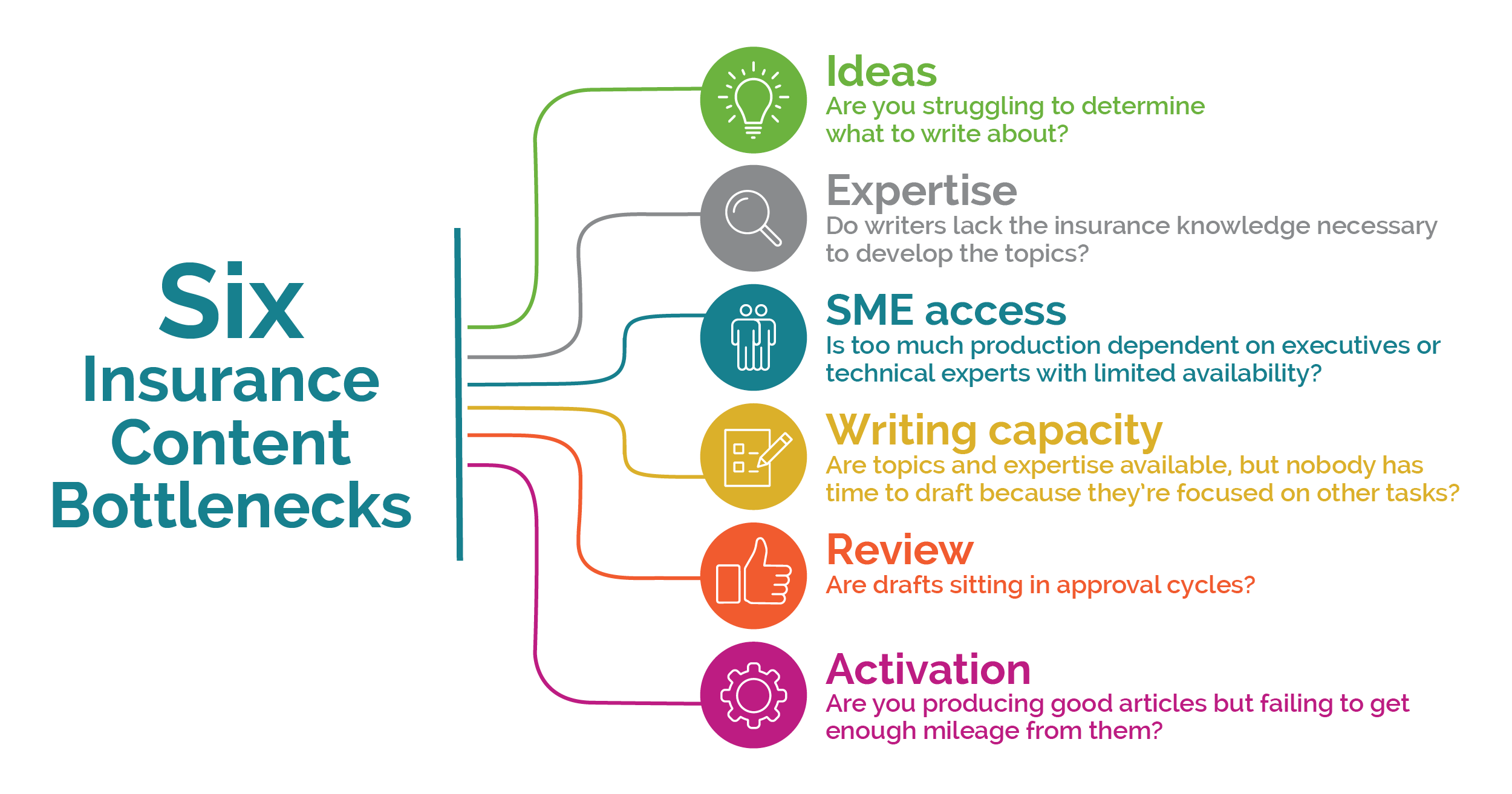
- Insurance content requires subject-matter knowledge. You can’t just pass the task off to anyone.
- Internal subject matter experts have limited time. The people who need to provide insights or review often have their plates full.
- Review cycles can slow production. Precision is absolutely essential, so you can’t cut corners when it comes to fact checking. Some content may need legal review or compliance approval.
- Generalist freelance writers may require extensive editing. Some pieces may need to go through multiple rounds of time-consuming revisions.
- Coordinating everything becomes complicated. Your marketing team isn’t just producing content. They’re interviewing experts and requesting approvals, and that takes coordination across multiple departments.
Insurance content writing is important to your organization’s long-term growth goals, but when urgent matters require the attention of your company leaders, it may not seem like a priority. As other responsibilities increase, the blog is often what slips.
Start by Finding the Real Constraint
If you want to produce more content, you may assume you need to hire more writers, but that may not solve the fundamental problem. Before adding to your staff or hiring an outside service, determine exactly what's preventing the current team from publishing more.
Five Ways to Increase Insurance Blog Production Without Another Full-Time Hire
Once you know where your blog production bottleneck is happening, you can implement strategies to increase content production – and it doesn’t have to involve adding a full-time hire to your team.
Here are five ways to increase insurance blog production
1. Build an editorial pipeline instead of starting from scratch every month.
If your marketing team has trouble coming up with compelling ideas to fill your content pipeline, the real problem may be that they’re staring at a blank page each month. A more efficient approach can fix this.
One reason topic planning becomes inefficient is that teams expect each brainstorming session to produce a new batch of fully formed ideas. A rolling topic bank removes that pressure.
Instead of starting from scratch each month, develop and then maintain a rolling topic bank. Build content around business priorities, customer questions, sales conversations, industry developments and existing authority topics. You can keep your topic bank fresh by adding new topics periodically, and by putting fresh spins on old ideas, but you’re building off of a core instead of starting all over, and that can be a lot easier. Batch planning also tends to be more efficient than holding repeated brainstorming sessions.
2. Get more from every subject matter expert conversation.
Your marketing team is busy. So are your subject matter experts. When you carve out time for an interview, you need to get as much from that time as possible.
One 30-minute interview shouldn't necessarily produce one article. Capture enough material to support multiple related articles, FAQs, commentary, social content or other assets. Your goal is to turn one conversation into the foundation for an entire content campaign that fosters content activation, not a single blog that is published and then forgotten.
To make this work, adjust your perspective before, during and after the interview.
- Before the interview, think about the different types of pieces you want to produce, and plan your questions accordingly.
- During the interview, be on the lookout for interesting insights, examples or digressions that could form the basis of new content.
- After the interview, review your notes or transcript and pick out sections that can be turned in to different pieces of content. Look for interesting perspectives and analogies that can be used to give the same basic idea a different spin.
3. Separate subject matter expertise from production.
If your subject matter experts never have enough time to devote to blogging, you may be asking too much of them.
Your underwriters, brokers, executives or clinical experts don't need to write the article. Their highest-value contribution may be 20 minutes of expertise that an experienced insurance writer turns into polished content.
Instead of asking your internal experts to provide an article, draft or notes, ask them to schedule a 20-minute interview. This way, they know exactly how much time they need to set aside, and they won’t have to worry about producing a quality article. They just have to answer questions and share their expertise, and then they can go back to their other responsibilities.
4. Use specialized external writing capacity.
 Someone has to write the actual article. Even if you add AI to the workflow, you’ll still need a human writer to verify facts, provide sources and ensure that the content reflects your brand’s voice and perspective.
If you don’t want to hire on more employees, you have three basic options:
- A freelancer. Good for organizations with predictable assignments and an established freelancer who already understands the business.
- A generalist agency. Good when broad marketing capabilities and high-volume production matter more than deep insurance specialization.
- An insurance-specialist writing partner. Good when content is technical, SME time is limited and reducing internal briefing/editing time is a priority.
When choosing outsourced insurance writers, think about the entire workflow. How will the outsourced partner work with your internal teams? Who will be responsible for what? Will this arrangement create new tasks or complications for your staff?
5. Stop measuring productivity only by article count.
There's another way to increase effective content capacity: stop treating every asset as a separate production job. Production efficiency involves more than just writing and publishing a blog quickly. It also means extracting greater value from everything that gets produced. If you’re writing dozens of articles but most of them underperform, it doesn’t matter how fast the process is. You’re still wasting valuable resources.
You can avoid wasting resources by pursuing a coordinated campaign that focuses on maximizing the value of each piece. For example, instead of commissioning five unrelated pieces, you can commission one substantial authority article and surround it with a capsule of derivative assets that extend its reach across channels.
Learn more about the content capsule strategy.
What Should Stay In-House and What Can Be Outsourced?
Although outsourced insurance content marketing can be a successful strategy, outsourcing the wrong tasks can undermine your success. If you retain tasks that should be outsourced, you’re overloading your team. If you outsource tasks that should be handled in-house, you risk publishing content that doesn’t accurately reflect your brand, your expertise or your standards.
Before you hire an outside writing partner, decide which tasks you want to retain and which tasks you want to outsource.
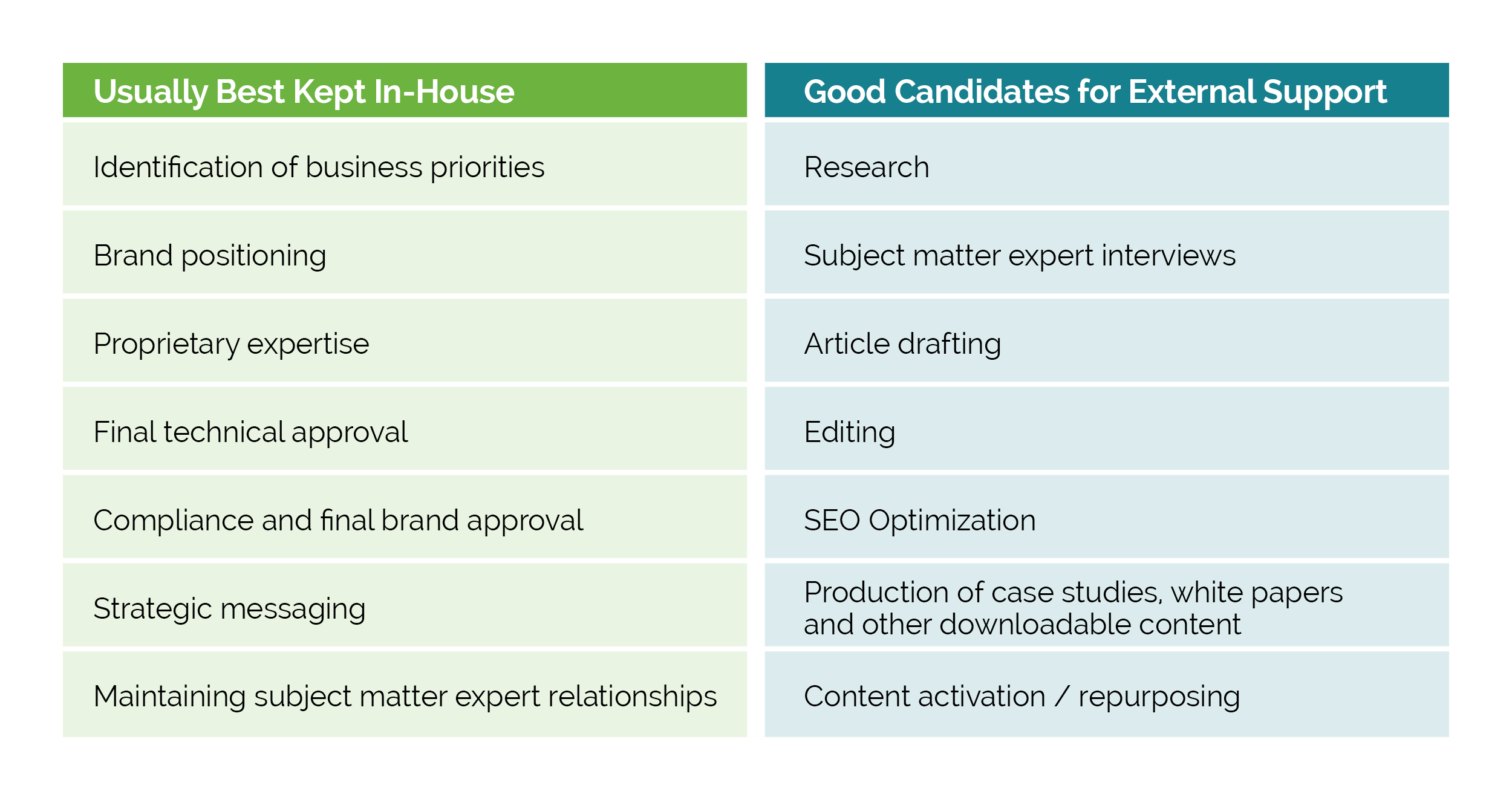
Your outsourced writing partner should augment, not replace, your team. External capacity works best when the internal marketing team retains ownership of strategy and expertise while removing production work from its plate.
When Does Outsourcing Make More Sense Than Hiring?
A full-time hire may make more sense when there is enough consistent work to occupy the role, especially if your organization needs that person deeply embedded in daily operations.
Outsourcing may make sense when:
- Content needs fluctuate month to month.
- The workload isn’t sufficient to justify a full-time position.
- You’re looking for a wide range of skills and expertise that may be hard to find in a single individual.
- Your team needs to increase production relatively quickly.
A Simple Model for Adding Capacity
To see how adding capacity can work, consider this example.
An insurance company’s marketing department wants to move from two articles per month to six. The department also wants to improve its capacity to act quickly on time-sensitive content opportunities, such as current events or legislative developments.
Instead of hiring another employee to take on the extra workload, the company can contract with an external insurance content team. The new workflow looks like this:
- The internal team sets priorities and identifies subject matter experts.
- The subject matter experts provide expertise through short interviews or source material.
- The external insurance content team researches, drafts, edits and prepares the articles.
- The internal team reviews, approves and publishes the article.
Before, everything was done in-house, so the internal team owned the strategy, the expertise and the production. Due to resource constraints, it wasn’t possible to increase production, and if a time-sensitive content opportunity emerged, it wasn’t always possible to act quickly enough to take advantage of it.
After, the internal team still owns the strategy and expertise, but the external team supplies production capacity. This arrangement frees up internal resources that can be reallocated to strategic planning while providing the flexibility needed to take advantage of time-sensitive content opportunities.
Are You Missing Out on Content Opportunities?
A well-timed and consistent content strategy can support your organization’s growth, but busy teams often miss out on content opportunities.
If your insurance marketing team has more content opportunities than production capacity, you may not need another employee. You may simply need the right extension of your existing team.
Inbound Insurance Marketing provides insurance-specialized writing capacity for articles, case studies, white papers and other technically demanding content. Learn more >